

An extraordinary and repetitive universe of color lived inside Yayoi Kusama’s mind, an artist who transformed early hallucinations into one of the most hypnotic and revolutionary works in contemporary art history.
Yayoi Kusama was born on March 22, 1929, in Matsumoto, Japan. She belonged to a conservative family dedicated to plant nurseries, growing up surrounded by fields of flowers. However, in rejection of family tradition and the abusive practices within her household, Yayoi took refuge in art, beginning to draw and paint prolifically from an early childhood.
Later on, she moved to Kyoto to study at the Municipal School of Arts and Crafts, where she was trained in traditional Japanese Nihonga painting. Inspired by Western Abstract Expressionism, however, she soon developed her own visual language and resolved to commit to it, firmly rejecting the conservatism of her environment. Driven by this pursuit, she left for New York in 1957 to immerse herself in the international avant-garde and explore this new creative path further.
BY CONFRONTING RIGID TRADITIONS AND INNER TRAUMA THROUGH REPETITIVE BRUSHWORK, KUSAMA TRANSFORMED ART INTO AN INSTINCTIVE ACT OF SURVIVAL.
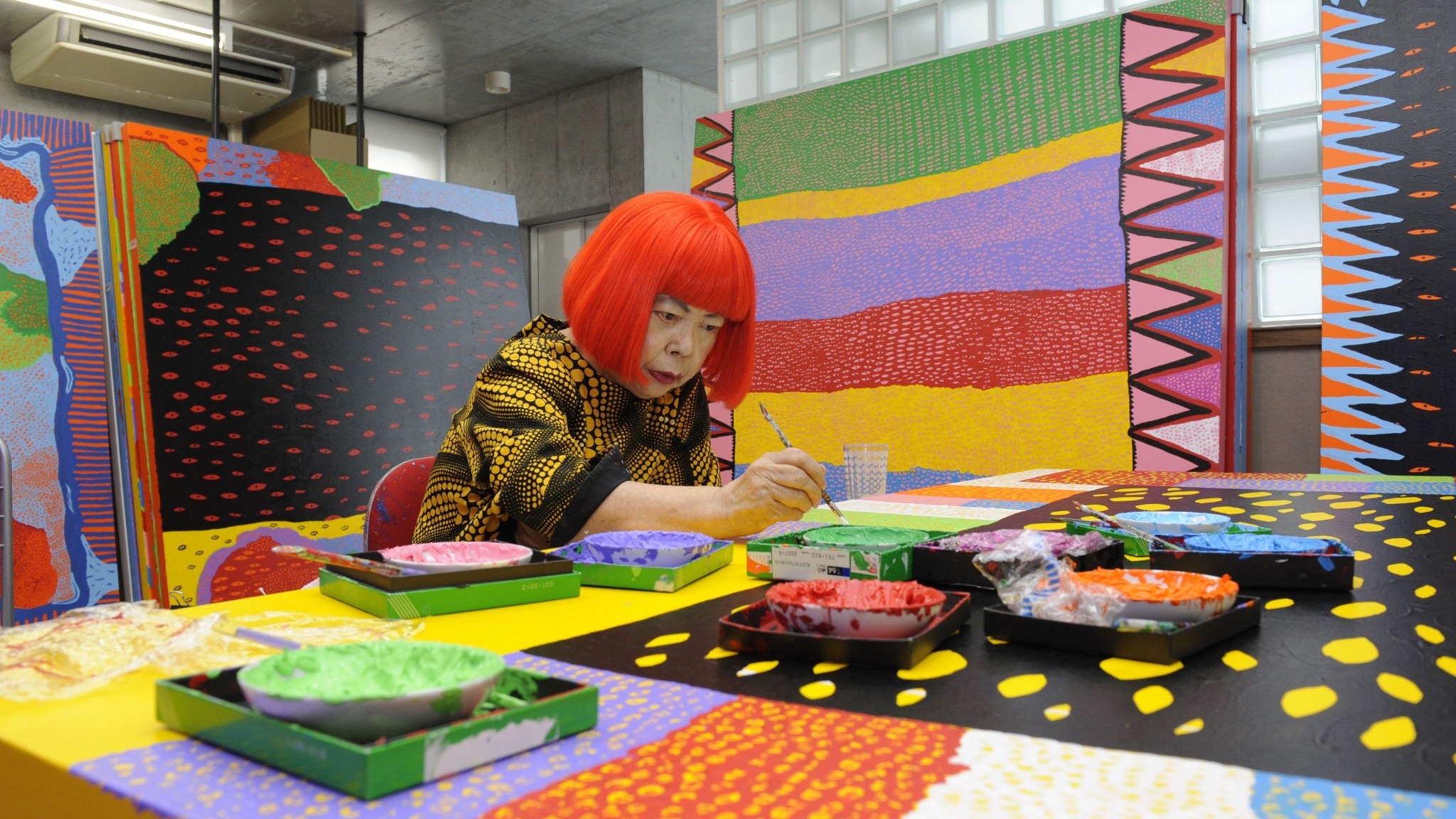
Upon arriving in New York, Kusama quickly established herself as a formidable force within the predominantly male artists. In 1959, she debuted her groundbreaking Infinity Nets at the artist-run Brata Gallery; monumental, monochromatic canvases covered in dizzying, repetitive brushstrokes that bridged the gap between Abstract Expressionism and emerging Minimalism.
These works soon expanded into three dimensions: by the early 1960s, she began crafting "soft sculptures" of furniture and domestic objects blanketed in stuffed fabric forms, confronting her anxieties around sexuality and domesticity. Her ambition culminated in 1965 with Infinity Mirror Room-Phalli’s Field, an immersive, mirrored environment that shattered the boundaries of traditional sculpture. By inviting viewers into an optically boundless cosmos, Kusama transformed her personal psychological struggles into collective experiences, where the individual dissolves into the infinite.
BEYOND THE TWO-DIMENSIONAL CANVAS, HER WORK EXPANDED INTO BOUNDLESS MIRRORED COSMOSES WHERE THE VIEWER DISSOLVES ENTIRELY INTO THE INFINITE.
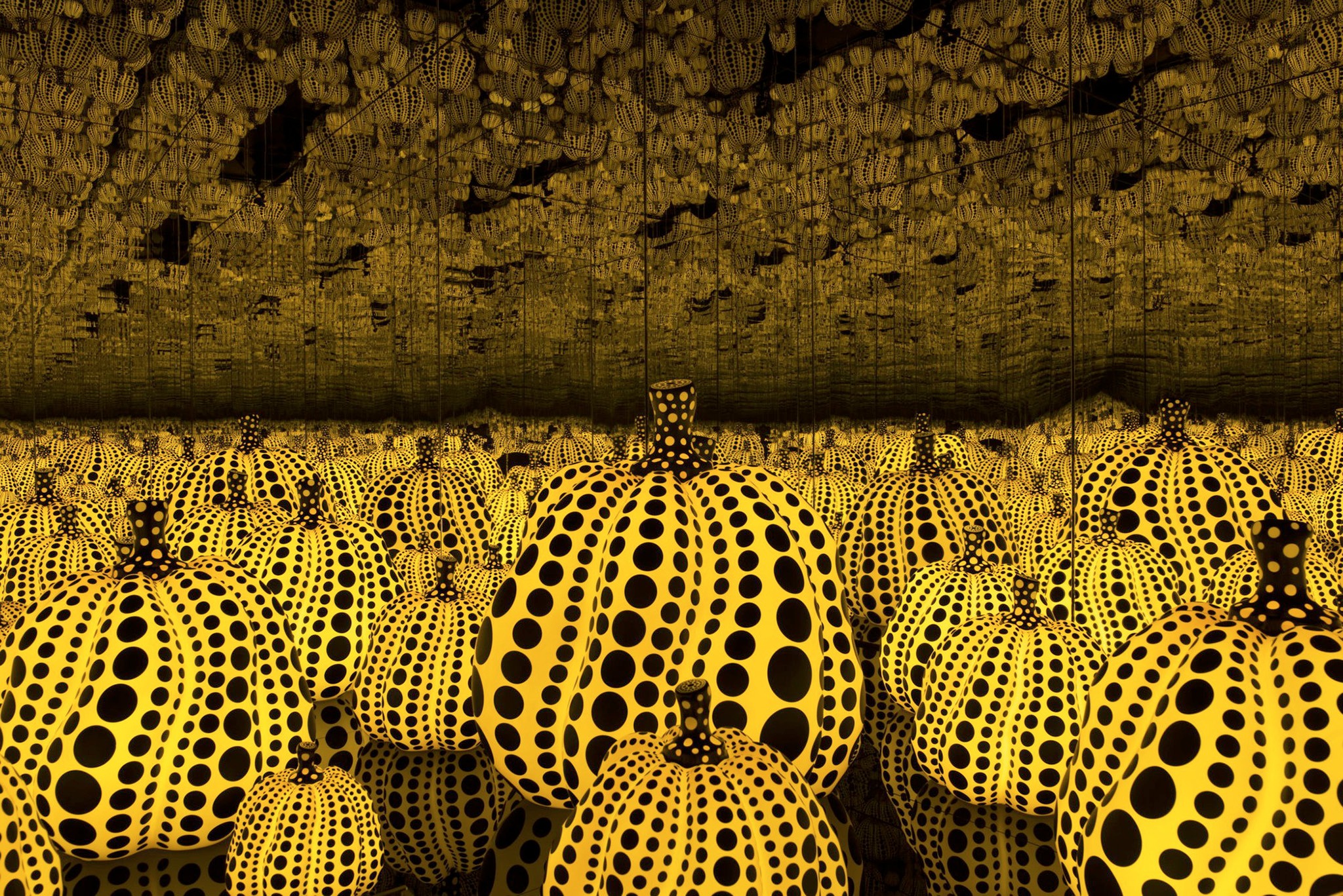
Her radical interventions did not stop inside the gallery; throughout the late 1960s, she orchestrated anti-war happenings and body festivals across Manhattan, painting polka dots onto naked performers as acts of socio-political protest. Though marginalized by an art establishment that frequently overlooked her innovations, Kusama’s tireless exploration of seriality, motifs, and space ultimately earned her indisputable historic recognition.
Her whimsical yet poignant dotted pumpkins, symbolic anchors of warmth and psychological fortitude, and her world-touring Infinity Mirror Rooms evolved into some of the most celebrated and visited installations of our era. What began as an intimate act of coping transformed into an extraordinary body of work that continues to captivate millions, securing her place as one of the most transformative, boundary-pushing figures in global contemporary art.
FROM AN UNCOMPROMISING AVANT-GARDE OUTCAST TO A TIMELESS GLOBAL PHENOMENON, KUSAMA TURNED OBSESSION INTO IMMORTALITY.