

Material, support, and technique. Everything changes in Tàpies’s work; however, there is one element that remains constant: the cross.
The early work of Antoni Tàpies was mainly surrealist. Influenced by artists such as Paul Klee and Joan Miró, numbers, letters, and graphic marks already appeared in his paintings.
Nevertheless, he quickly evolved toward the development of a unique abstract style, incorporating geometrizing elements and studies of color, becoming the greatest exponent of material painting, one of the main branches of Informalism.
With Tàpies’s shift toward material Informalism, signs are integrated into the surface of his works as a language of their own.
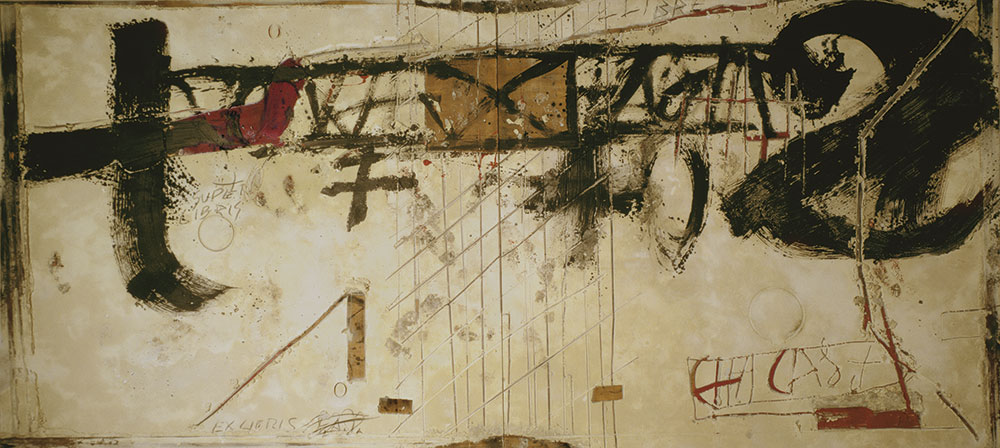
The sign that appears consistently throughout Tàpies’s oeuvre is the cross. Two forcefully marked strokes, polysemic in nature, as they can hold many meanings at the same time.
At times this cross signifies the vertical, symbolizing both the spiritual and the material.
At other moments, it functions as a way of ordering: it marks space and time. It can also indicate the boundary between human knowledge and nature and spirit. Tàpies stated that if his work served any purpose, it was to encourage meditation and reflection on our lives.

In other instances, the cross becomes a pair of scissors.
The X occasionally turns into a T, the letter with which his surname begins. This was a way of representing the relationship he felt between himself and his work. Tàpies means “wall” in Catalan, and at times Antoni transforms his canvases into walls. He sought to make his works resemble walls: rough, cracked, eroded, bearing traces and signs.
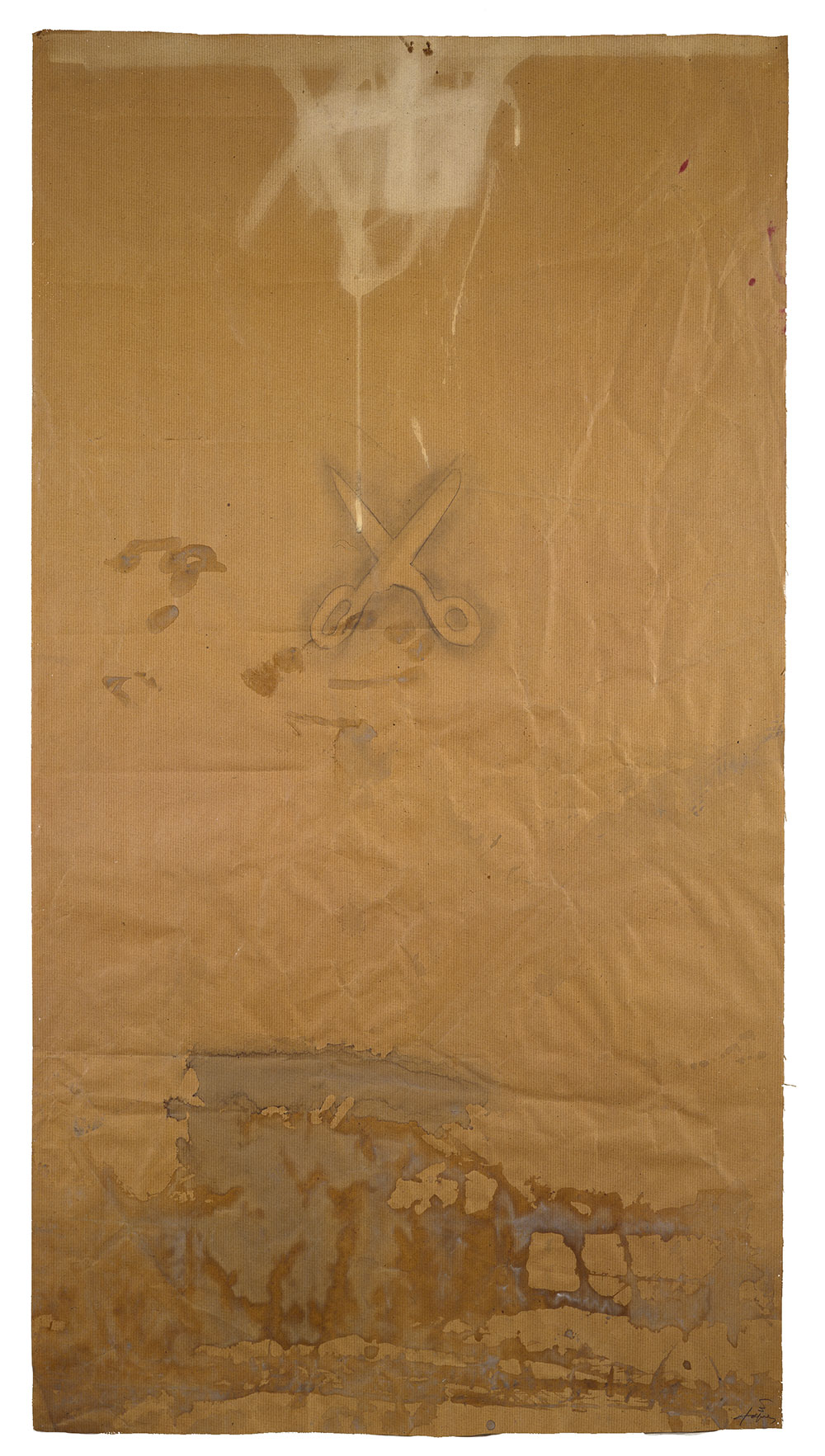
“Images of the cross and crossings, of opposing lines and planes, of intersections of contrary forces, are considered in many cultures to be a fundamental symbolic representation of the world.” (Antoni Tàpies, Crosses, Xs, and Other Contradictions, 1994)