

Les demoiselles d’Avignon is a painting that depicts five nude female figures, but the origin of its creation stems from a tragic event.
At the beginning of the 20th century, the French capital, known as the City of Light, was also the world capital of art. Paris was a vibrant, bohemian epicenter that attracted creators from all over the world, including Pablo Picasso and his friend Carlos Casagemas, who was also a painter.
Picasso and Casagemas traveled to Paris for the first time in 1900 to visit the Universal Exposition.
One night, in the bohemian atmosphere of Paris, Casagemas met a model and prostitute named Germaine Gargallo. They had a romantic relationship, but Germaine did not reciprocate Casagemas’s feelings as he wished.
Casagemas became distraught over love, and Picasso decided to remove him from the situation by taking him to his hometown of Málaga for the Christmas holidays. They soon returned to Paris, and during a dinner with friends at the Café Hippodrome, Casagemas attempted to murder Germaine with a pistol and then turned the gun on himself, ending his life. Picasso did not witness this moment, but this tragedy marked him forever, both personally and in his artistic work.
Picasso was so affected by the suicide of his friend Casagemas that he completely changed his artistic style and dedicated at least three works to him.
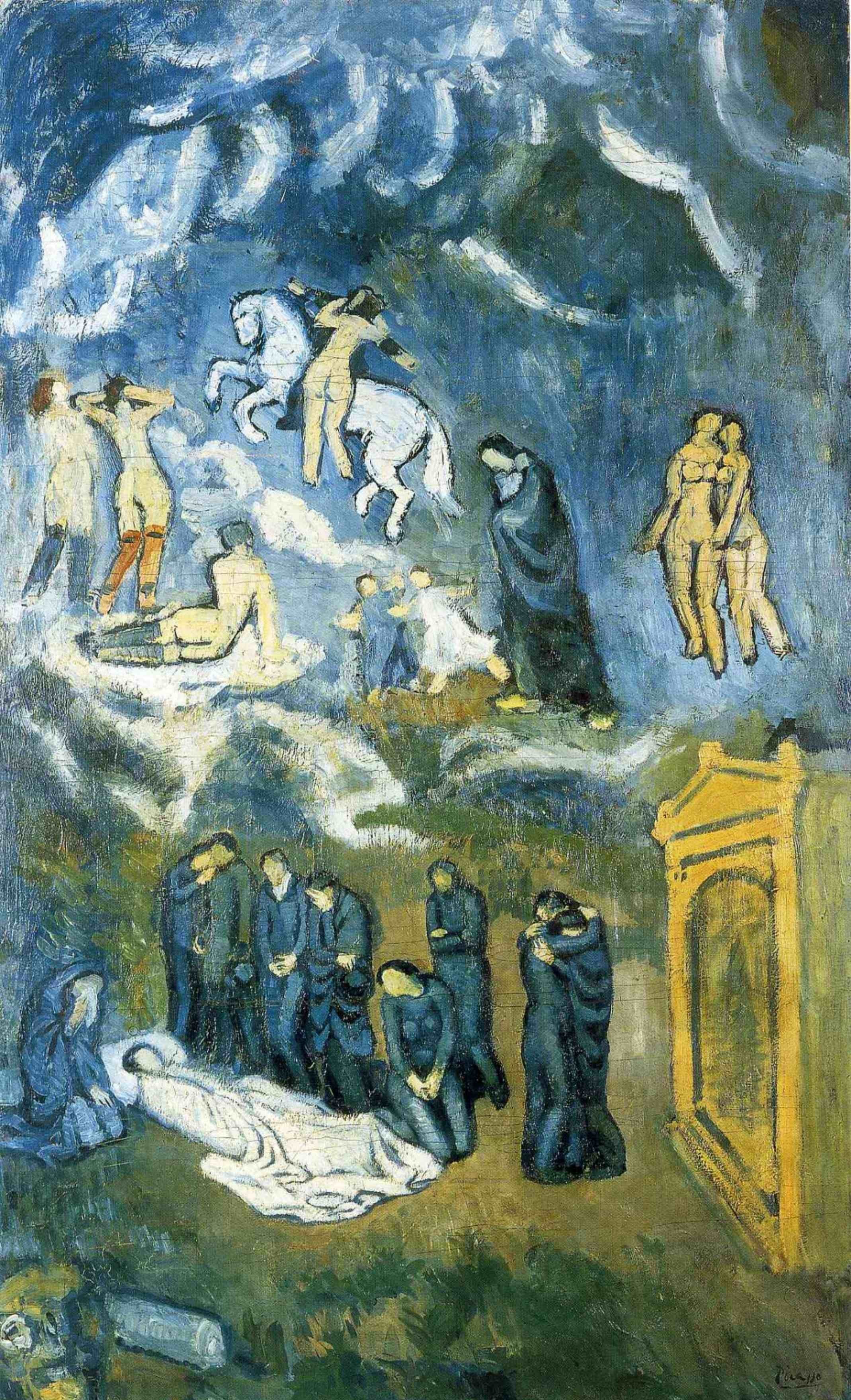
In two of them, La muerte de Casagemas (1901) and Casagemas en su ataúd (1901), the deceased appears in the coffin. In the third, Evocación (El entierro de Casagemas) (1901), people mourn his death. To create this work, Picasso was inspired by one of the masters of the Spanish tradition in which he was raised, El Greco, and specifically by his painting El entierro del Conde Orgaz (1586).
The composition of Picasso’s work presents the earthly realm at the bottom and the celestial realm at the top, just as in the painting that inspired him. However, while the painter from Toledo depicted Christ and Mary in the sky, Picasso chose to paint a group of nude women who are prostitutes. One of them, who might represent Germaine, says goodbye to Casagemas, a figure leaving on a white horse. From this scene the work Les Demoiselles d'Avignon will be born.

Evocación (El entierro de Casagemas) is undoubtedly the closest precursor to Les Demoiselles d'Avignon (1907), a work Picasso created six years later, considered the beginning of Cubism.
This painting breaks with traditional perspective and volume, and due to its new forms of representation, it is considered proto-Cubist, belonging to the transitional phase of Cubism. The simplification of forms into geometric volumes was influenced by Cézanne and African art.
The painting was created in Paris, but the title, given by Salmon, refers to a street in Barcelona known for its many brothels. Picasso began working on this painting in 1906 through sketches that filled up to sixteen notebooks.
