

Artist Eline Boerma has given us an interview about her work, which is currently on display at VILLAZAN Gallery Madrid. The exhibition, "The weather, the world, my mind," will be on view until July 23.
1. How did your interest in painting begin?
Painting started as something I could express my emotions through, but I was quickly drawn to the fact that there always seemed to be another challenge, another possibility, another way of pushing the work further. The desire to make a better painting than the one before still motivates me. Over time, it became a way of thinking through the world rather than simply representing it.
2. The title of the exhibition, The Weather, the World, My Mind, suggests a connection between the exterior and the interior. How do these three elements interact in your work?
For the title, I wanted to suggest a sense of location, movement and interconnectedness. I chose "weather" because it emphasises movement. Unlike a landscape, which can sound fixed, it is constantly changing, and it affects everything around us. In that sense, it became a way of thinking about larger systems and the forces that shape our lives. "The world" refers to the physical environment and the social and political realities we live through. News, daily life, and collective anxieties inevitably enter my thinking and sometimes seep into the work. "My mind" is where all of these experiences are processed, transformed, and filtered. But there are also the internal landscapes which add another layer. For me, painting is a way of making sense of that relationship between the external and the internal. The paintings are not depictions of specific landscapes or states of mind, but attempts to embody the movement between them.
3. Your work is highly abstract, yet it evokes nature. How do you achieve this balance?
I think my work always has some references and is never fully abstract. Traces of nature can be found in the work, not directly illustrated but more as a structure or reference. In some paintings you can find a resemblance of a horizon and there often is a play with light. I'm also interested in the rhythms, movements, and colours found in landscape or natural phenomena. Through colour, gesture, layering, and spatial relationships, I try to create experiences that feel analogous to those forces without directly illustrating them. Depth in the painting is important and the movement can feel immersive, in a way similar to swimming in the sea or walking through a forest. The paintings remain mostly abstract, but traces of landscape and figures often emerge and dissolve within them. Form slips into ground and boundaries push and leak rather than hold.
4. What do you find in abstract painting that leads you to move away from figurative painting?
Abstraction allows me to explore things that are difficult to express through a fixed image. It creates space for ambiguity and transformation and there is a certain freedom to it. While figurative painting often begins with recognition, abstraction can operate through sensation, movement, and the physical act of painting itself. What interests me is not so much representing something that is already known, but allowing something to emerge through the process of painting. It gives me the possibility to hold different tensions at once, between abstraction and reference, control and chaos, movement and suspension. I still draw a lot from memory, art history, landscape, and the figure, but abstraction allows those references to remain more indirect. It feels closer to how you can listen to music, how the work can be an experience which you can keep looking at. Like a song playing on repeat while your eyes keep wandering over the surface of the painting. And each time you notice other elements in the song.
5. Natural elements such as water, wind, and light are present in your work. What do you find in these elements that inspires you? How do you capture these fleeting experiences in paint?
I'm drawn to these elements because they are constantly changing and resist being fully grasped. They exist through movement and transformation rather than permanence. In painting, I try to translate those qualities through layering, transparency, shifts in density, and variations in gesture. The process itself often mirrors these natural dynamics: paint is pushed, diluted, accumulated, erased, and reworked. I want the painting to feel like it could move off the canvas. In a way many of my paintings come from the sea. That's where I feel the most free and I have often wanted to translate that freedom and feeling of boundlessness to the canvas.
6. Your painting is highly gestural, and the brushstrokes appear completely accidental. What role do conscious decisions actually play during the creative process?
For me it is not really accidental. There are elements of intuition and impulse, but conscious decision-making is present throughout the entire process. There is a constant negotiation between action and reflection. My process consists of short moments of fast mark-making followed by long periods of looking. What may appear accidental is usually the result of many decisions regarding rhythm, colour, balance, tension, and structure. I'm interested in preserving a sense of spontaneity while also allowing the painting to develop its own internal logic.
7. Is there any artist who has had a particularly significant influence on your work?
I draw on a broad range of influences from art history. One of the painters I keep coming back to is Chaïm Soutine. What draws me to his work is the way his landscapes never seem to settle. Everything feels as though it is moving, twisting, or shifting. The brushstrokes carry a huge amount of energy, and the landscape feels alive. I'm also fascinated by the way he paints light. His paintings seem to glow from within. More generally, one of the things I love most about painting is seeing how different artists deal with light and atmosphere. Light is constantly changing and impossible to hold onto, yet painting has this unique ability to make those fleeting experiences tangible. Sometimes paintings from art history can also be a starting point for a painting. Like one of the paintings in the show “A desire for the impossible” which had John Singer Sargent’s Gassed as a starting point. The idea of the line in his painting was something slightly different, because with most works in the show I have been thinking about the idea of a cluster or something either being compressed or going outward. I think time, movement and direction in many of the paintings are slightly different, like different tempo’s of songs.
8. Could you tell us about your creative process?
Each work is an exploration in the constant search which drives me, making something better than before. I am always searching for something more alive, more honest, more generous than before. I never begin with a fixed image in mind. Painting is a space for reflection, for staying with questions, and for being open to where the work wants to go. I often work on multiple canvases at once, working through a cycle of fast, impulsive mark-making, followed by long periods of observation and reflection. The paintings are built over several layers. It is a process of building, destruction and reconstruction. I don't want the work to feel too resolved. I think painting needs a certain amount of resistance, and I like it when traces of that struggle remain visible on the surface.
9. Do you believe that works of art are ever truly finished? At what point do you recognize that a work is complete?
I do definitely think paintings can be finished, although I sometimes change my mind later. I want the work to still be able to breathe, so I don't want to overwork it. Often, I know a painting is close to being finished when I start looking at the work without being annoyed by parts of it and I can spend time looking at it without immediately wanting to change something. I'm not looking for a painting to feel completely resolved. What matters more is that it holds a certain tension and that my eyes can keep wandering over the surface. At a certain point, you realise that any further changes would diminish the painting rather than strengthen it, and that's when I know it's time to stop. It's often an intuitive decision based on looking and living with the work over time.
10. Your paintings seem to resist immediate viewing. How do you achieve this, and what importance do you give to the viewer’s gaze?
I don't want to make paintings that can be immediately understood and consumed. I'm not interested in the kind of image where you look at it, think "I get it," and move on. I like the idea that the viewer has to do some work, that things reveal themselves slowly over time. Lines are crossed out, surfaces are built up and scraped back, and meaning remains open rather than fixed. Through layering, reworking, I try to create unstable spaces between image and erasure where elements emerge and recede depending on how long one spends with the work.The viewer's gaze is an important part of that process. Each person will navigate the work differently. I'm interested in creating spaces that reward looking and spending time with the painting, that remain alive and unresolved.
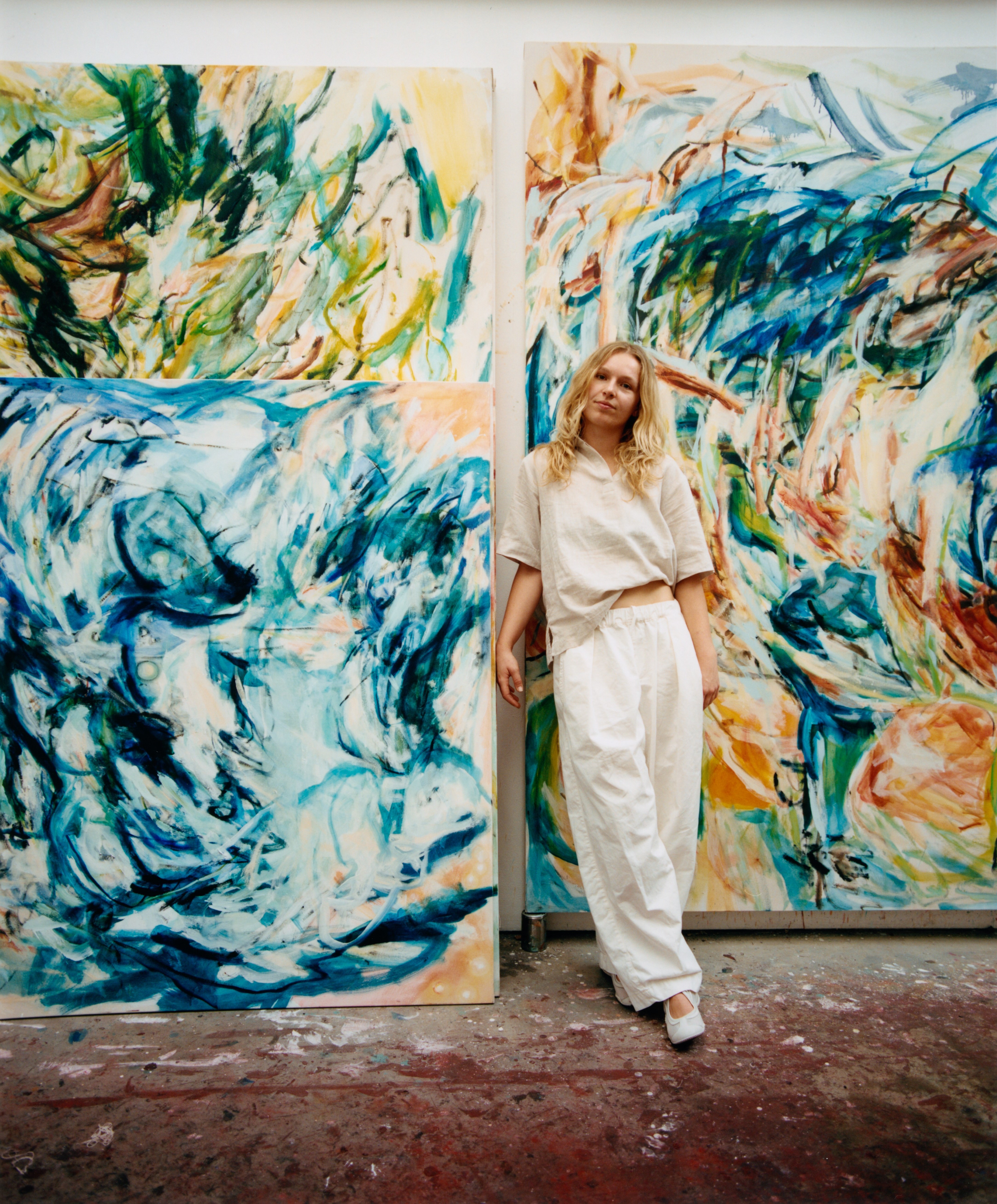
La artista Eline Boerma nos concede una entrevista sobre su obra, actualmente expuesta en la Galería VILLAZAN de Madrid. La muestra, "The weather, the world, my mind", podrá visitarse hasta el 23 de julio.
1. ¿Cómo comenzó tu interés por la pintura?
La pintura comenzó siendo una forma de expresar mis emociones, pero pronto me atrajo el hecho de que siempre parecía haber un nuevo desafío, una nueva posibilidad, una nueva manera de llevar la obra un paso más allá. El deseo de hacer una pintura mejor que la anterior sigue siendo lo que me motiva. Con el tiempo, se convirtió en una forma de pensar el mundo más que simplemente de representarlo.
2. El título de la exposición, The Weather, the World, My Mind, sugiere una conexión entre el exterior y el interior. ¿Cómo interactúan estos tres elementos en tu obra?
Con el título quería sugerir una sensación de lugar, movimiento e interconexión. Elegí "el tiempo" (weather) porque enfatiza el movimiento. A diferencia del paisaje, que puede sonar fijo, el tiempo está en constante cambio y afecta a todo lo que nos rodea. En ese sentido, se convirtió en una forma de pensar en sistemas más amplios y en las fuerzas que moldean nuestras vidas.
"El mundo" se refiere tanto al entorno físico como a las realidades sociales y políticas que vivimos. Las noticias, la vida cotidiana y las inquietudes colectivas inevitablemente forman parte de mi pensamiento y, a veces, se filtran en la obra. "Mi mente" es el lugar donde todas esas experiencias se procesan, transforman y filtran. Pero también existen los paisajes interiores, que añaden otra capa de significado. Para mí, pintar es una forma de comprender la relación entre lo externo y lo interno. Las pinturas no representan paisajes concretos ni estados mentales específicos, sino que intentan encarnar el movimiento constante entre ambos.
3. Tu trabajo es muy abstracto, pero al mismo tiempo evoca la naturaleza. ¿Cómo consigues ese equilibrio?
Creo que mi trabajo siempre contiene referencias y nunca es completamente abstracto. En él pueden encontrarse huellas de la naturaleza, no como una ilustración directa, sino más bien como una estructura o un punto de referencia. En algunas pinturas puede percibirse la sugerencia de un horizonte y suele haber un juego con la luz.
También me interesan los ritmos, los movimientos y los colores presentes en el paisaje y en los fenómenos naturales. A través del color, el gesto, las superposiciones y las relaciones espaciales, intento crear experiencias que sean análogas a esas fuerzas sin ilustrarlas de forma literal.
La profundidad de la pintura es importante y el movimiento puede resultar inmersivo, de una manera similar a nadar en el mar o caminar por un bosque. Las pinturas permanecen mayoritariamente abstractas, pero en ellas aparecen y desaparecen rastros de paisajes y figuras. La forma se desliza hacia el fondo y los límites se expanden y se desbordan en lugar de contener.
4. ¿Qué encuentras en la pintura abstracta que te lleva a alejarte de la pintura figurativa?
La abstracción me permite explorar cosas que son difíciles de expresar mediante una imagen fija. Crea un espacio para la ambigüedad y la transformación, y ofrece una cierta libertad.
Mientras que la pintura figurativa suele partir del reconocimiento, la abstracción puede funcionar a través de la sensación, el movimiento y el propio acto físico de pintar. Lo que me interesa no es tanto representar algo que ya es conocido, sino permitir que algo emerja durante el proceso de pintura.
Me da la posibilidad de mantener simultáneamente distintas tensiones: entre abstracción y referencia, control y caos, movimiento y suspensión. Sigo nutriéndome de la memoria, de la historia del arte, del paisaje y de la figura humana, pero la abstracción permite que esas referencias permanezcan más indirectas.
Se parece más a la experiencia de escuchar música: la obra se convierte en una experiencia a la que puedes volver una y otra vez. Como una canción sonando en bucle mientras los ojos recorren la superficie del cuadro. Y cada vez descubres nuevos matices en la canción.
5. Elementos naturales como el agua, el viento y la luz están presentes en tu obra. ¿Qué encuentras en ellos que te inspira? ¿Cómo capturas esas experiencias efímeras en la pintura?
Me atraen estos elementos porque están en constante cambio y se resisten a ser comprendidos por completo. Existen a través del movimiento y la transformación, más que de la permanencia.
En la pintura intento traducir esas cualidades mediante capas, transparencias, cambios de densidad y variaciones gestuales. El propio proceso refleja esas dinámicas naturales: la pintura se empuja, se diluye, se acumula, se borra y se vuelve a trabajar.
Quiero que la pintura dé la sensación de poder escapar del lienzo. En cierto modo, muchas de mis obras nacen del mar. Es el lugar donde me siento más libre y, con frecuencia, he querido trasladar esa sensación de libertad y de ausencia de límites al lienzo.
6. Tu pintura es muy gestual y las pinceladas parecen completamente accidentales. ¿Qué papel desempeñan realmente las decisiones conscientes durante el proceso creativo?
Para mí no son realmente accidentales. Hay elementos de intuición e impulso, pero la toma de decisiones consciente está presente durante todo el proceso.
Existe una negociación constante entre la acción y la reflexión. Mi forma de trabajar consiste en breves momentos de gestos rápidos seguidos de largos periodos de observación.
Lo que puede parecer accidental suele ser el resultado de muchas decisiones relacionadas con el ritmo, el color, el equilibrio, la tensión y la estructura. Me interesa preservar una sensación de espontaneidad y, al mismo tiempo, permitir que la pintura desarrolle su propia lógica interna.
7. ¿Hay algún artista que haya tenido una influencia especialmente importante en tu trabajo?
Me inspiro en una amplia variedad de referentes de la historia del arte. Uno de los pintores a los que vuelvo constantemente es Chaïm Soutine. Lo que me atrae de su obra es la manera en que sus paisajes nunca parecen estabilizarse. Todo da la sensación de estar moviéndose, retorciéndose o transformándose. Sus pinceladas contienen una enorme energía y el paisaje parece estar vivo. También me fascina la forma en que pinta la luz. Sus pinturas parecen iluminarse desde dentro. En un sentido más amplio, una de las cosas que más me apasionan de la pintura es observar cómo distintos artistas trabajan la luz y la atmósfera. La luz cambia constantemente y es imposible retenerla, pero la pintura posee la capacidad única de hacer tangibles esas experiencias fugaces.
En ocasiones, obras de la historia del arte sirven también como punto de partida para una pintura. Por ejemplo, una de las obras de la exposición, A Desire for the Impossible, parte de Gassed de John Singer Sargent.
La idea de la línea en esa pintura era distinta, porque en muchas de las obras de la exposición he estado pensando en la noción de un grupo o una masa que se comprime o se expande hacia el exterior. Creo que el tiempo, el movimiento y la dirección varían de una pintura a otra, como diferentes tempos de canciones.
8. ¿Podrías contarnos cómo es tu proceso creativo?
Cada obra es una exploración dentro de esa búsqueda constante que me impulsa: hacer algo mejor que antes. Siempre estoy buscando algo más vivo, más honesto y más generoso que en la obra anterior.
Nunca comienzo con una imagen fija en la cabeza. La pintura es un espacio para la reflexión, para permanecer con las preguntas y para estar abierto a donde la propia obra quiera llevarme. A menudo trabajo en varios lienzos al mismo tiempo, alternando ciclos de gestos rápidos e impulsivos con largos periodos de observación y reflexión. Las pinturas se construyen mediante múltiples capas. Es un proceso de construcción, destrucción y reconstrucción. No quiero que la obra se sienta demasiado resuelta. Creo que la pintura necesita una cierta resistencia, y me gusta que las huellas de esa lucha permanezcan visibles en la superficie.
9. ¿Crees que las obras de arte llegan alguna vez a estar verdaderamente terminadas? ¿En qué momento reconoces que una obra está completa?
Sí, creo que las pinturas pueden llegar a estar terminadas, aunque a veces después cambie de opinión.
Quiero que la obra siga respirando, por lo que no deseo trabajarla en exceso. A menudo sé que una pintura está cerca de finalizar cuando puedo contemplarla sin que haya partes que me molesten y soy capaz de pasar tiempo observándola sin sentir la necesidad inmediata de cambiar algo.
No busco que una pintura parezca completamente resuelta. Lo importante es que conserve una cierta tensión y que mis ojos puedan seguir recorriendo su superficie.
Llega un momento en que comprendes que cualquier cambio adicional debilitaría la pintura en lugar de fortalecerla. Ahí es cuando sé que es el momento de detenerme. Suele ser una decisión intuitiva que nace de convivir con la obra y observarla durante un tiempo.
10. Tus pinturas parecen resistirse a una contemplación inmediata. ¿Cómo consigues ese efecto y qué importancia tiene para ti la mirada del espectador?
No quiero hacer pinturas que puedan entenderse y consumirse de inmediato. No me interesa ese tipo de imagen que se mira, se piensa "ya la entiendo" y se deja atrás.
Me gusta la idea de que el espectador tenga que implicarse, que las cosas se revelen lentamente con el paso del tiempo.
Las líneas se tachan, las superficies se construyen y luego se raspan, y el significado permanece abierto en lugar de quedar fijado. Mediante las capas y el continuo rehacer de la pintura, intento crear espacios inestables entre la imagen y el borrado, donde los elementos aparecen y desaparecen según el tiempo que uno dedique a contemplarlos.
La mirada del espectador es una parte esencial de ese proceso. Cada persona recorrerá la obra de una manera distinta. Me interesa crear espacios que recompensen la observación atenta y el tiempo dedicado a la pintura, que permanezcan vivos y sin resolver.
